
Introduction
India is undergoing an unprecedented growth of its infrastructure and manufacturing sectors. Highways and bridges, power transmission towers and telecom networks are all dependent on steel. Steel has one drawback: it rusts. That's where Hot Dip Galvanising Plants come in – and with it, a Galvanizing Plant India is fast emerging as a strategic investment for industrial players across India!
Plast World, a trusted brand in providing industrial solutions, recognizes the importance of corrosion protection to enhance the durability of infrastructure. The company has a suite of advanced galvanizing technologies, helping industries in India to construct robust and secure assets while strengthening their sustainability.
What Is a Hot Dip Galvanizing Plant?
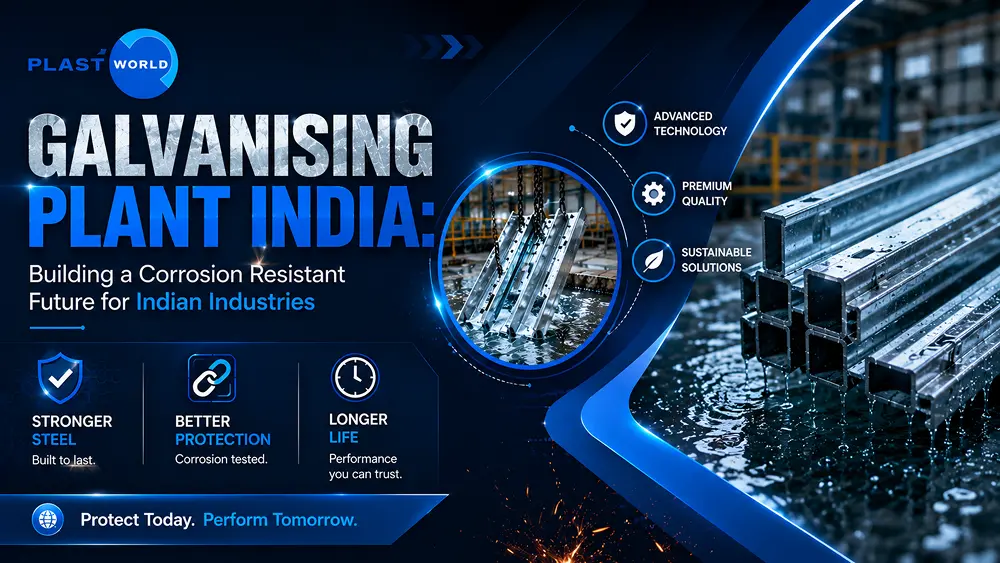
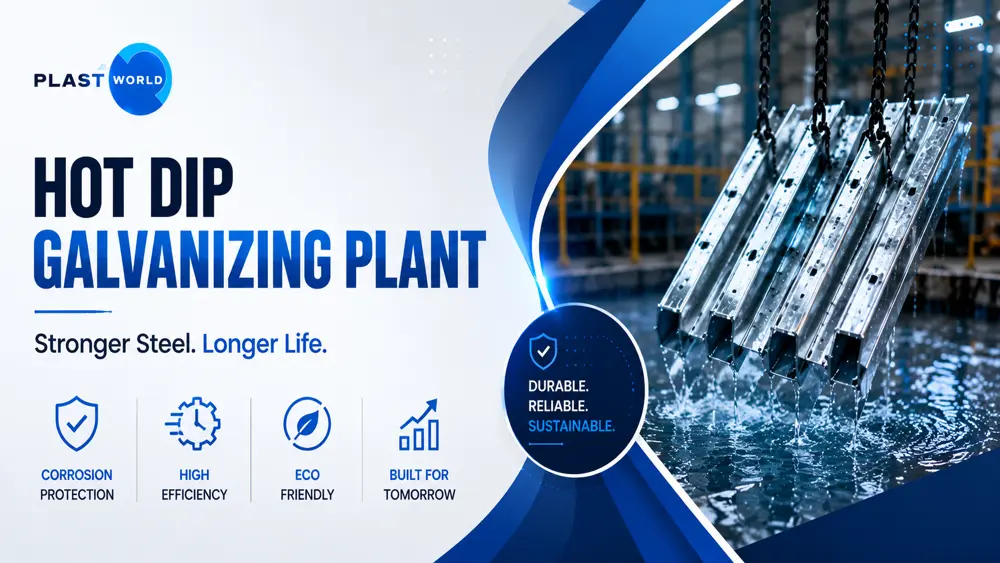
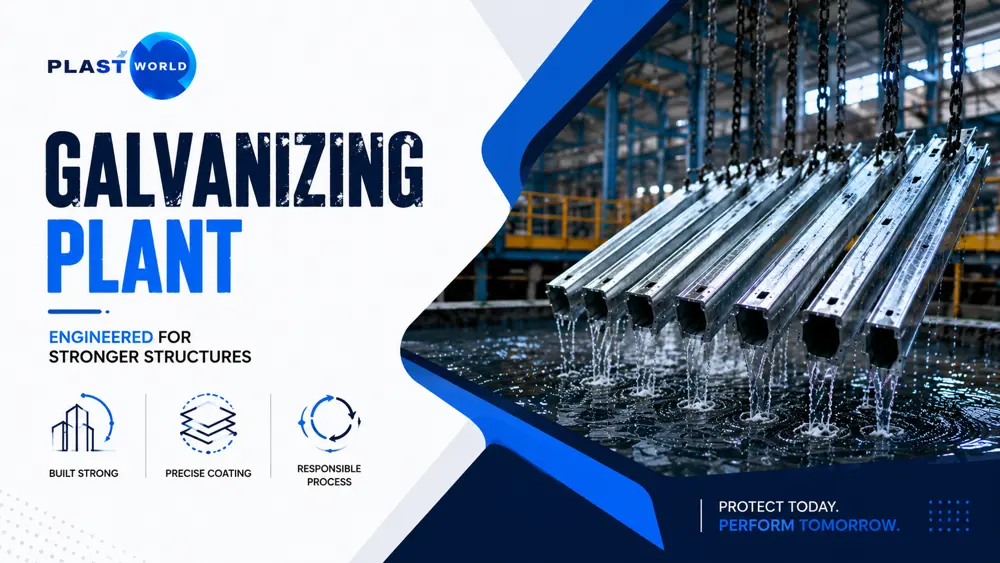
Hot Dip Galvanizing Plant is an industrial plant that dips steel and metal parts into molten zinc to provide a protective layer of zinc on the surface of the parts. In layman's terms, the cleaned steel is dipped in a bath of molten zinc, creating a metallurgical bond between the cleaned metal and the molten zinc. This bond forms a hard, consistent layer that protects against corrosion, wear and tear and environmental damage.
These plants can be used for small fittings and fastenings up to large structural sections, pylons, and poles. Using the appropriate Hot Dip Galvanizing Plant, the manufacturer can create steel structures that require minimal and light repainting and maintenance for decades. Plast World is using such technology to create high-quality, long-lasting results for its partners and clients.
Why Corrosion Protection Matters in India
The climate in India is not kind towards raw steel. Corrosion is hastened by high humidity, coastal salt, monsoon rains, and industrial pollution. Rust can develop in unprotected steel structures within months and begin to take its toll on the structure within a couple of years.
The corrosion isn't only an issue with the steel; it's a business impact. Recurring maintenance, repairs, downtime and even partial replacement costs of structures can easily exceed the initial installation costs over time. Investing in Galvanizing Plant in India can help businesses:
- Protect steel structures for a longer period of time.
- Minimise touch-up and maintenance expenses.
- To prevent unexpected shutdowns and service interruptions.
- Improve safety and reliability of infrastructure.
How a Hot Dip Galvanizing Plant Works
Modern Hot Dip Galvanizing Plant uses a well-designed process to guarantee uniform, superior coating:
- Surface Preparation: Oils, rust and scale are removed from the steel by degreasing, pickling and fluxing. This cleaning process is very important because any contamination may destroy the bond between zinc and steel.
- Heating in a Molten Zinc bath: The pre-treated steel is immersed in a Zinc bath (usually at about 450°C). The zinc chemically reacts with the steel, creating zinc–iron alloy layers which are then encapsulated by a pure zinc layer.
- Cooling and Inspection: Following the withdrawal, parts are cooled and then checked for thickness, adhesion and uniformity. At high levels, advanced plants incorporate automated handling and inspection systems to provide a close quality control.
These stages are optimized in a Galvanizing Plant India to manage high volumes, complex geometries and a wide range of product profiles, precisely what the infrastructure and manufacturing needs in India. Plast World is promoting the incorporation of these optimized processes into production in order to make the operation smoother in large scale production.
Galvanising Plant India: Catering to Diverse Industries
India has a diverse array of industries that depend on durable and corrosion-resistant components. A Galvanizing Plant India can cater to several industries in one premise:
- Construction & Infrastructure – Used to build steel beams, columns, grating and connectors for buildings, bridges and flyovers.
- Power & Transmission – Poles, towers and fittings for power lines and substations.
- Telecom & High Mast Lighting – Streetlight poles, telecom towers, antenna mounts.
- Renewables & Railways – Solar structures, railway components, and crossover supports.
- Examples of Pipes & Pre-fabricated Structures - Structural steel pipes, fencing and industrial enclosures are all
The introduction of Hot Dip Galvanizing Plant in the production chain will enable Indian manufacturers to provide end-to-end corrosion-resistant solutions which will comply with the national and international standards. Plast World works with these manufacturers to maximize their coating process and product reliability.
Advantages of Hot Dip Galvanizing for Indian Industries
Hot Dip Galvanizing has some unique benefits over painting or other coating processes:
- Superior Corrosion Resistance – Galvanized coatings will last 30-50 years in less severe environments and continue to be effective in more severe coastal and industrial environments.
- Unlike paint, which can chip or wear thin in problem areas, a protective layer is provided for all edges, corners and internal surfaces with Complete Coverage.
- Reduced maintenance, fewer recoating cycles and greater service life equates to lower Lifecycle Costs.
- Eco Friendly & Recyclable – Galvanized steel is 100% recyclable and new plants have been built for reduced emissions and chemical waste.
- Faster Turnaround – The galvanizing process is relatively quick once the plant is running and will allow for high throughput production schedules.
These benefits, for a Galvanizing Plant India, are directly evident in the form of competitive advantage, in terms of higher quality, better reliability and customer trust. Plast World is with industries in the quest to seize these benefits and enhance product durability and market positioning.
Setting Up a Galvanising Plant in India
When you start to plan a Galvanizing Plant India, you need to have a clear idea of the capacity, product range and market demand. Key considerations include:
- The line needs to be laid out so that it can run smoothly from when the raw material arrives until it is cleaned, galvanized and packed.
- Larger kettles and automation level: Better consistency and throughput, particularly for structural steel and long poles.
- Environmental Compliance – It is necessary to control emissions, treat effluent, and deal properly with pickling acids and flux compounds in order to gain regulatory approval.
- Traceability and compliance to IS, ASTM and ISO standards are maintained through the use of Quality Control Systems such as thickness gauges, inspection stations and digital logging.
Currently, numerous manufacturers and suppliers from India provide turnkey Hot Dip Galvanizing Plant solutions, providing from basic design to installation, commissioning, and operator training. Plast World closely works with technology partners to enable industries to select and apply appropriate plant configuration to their needs.
Future Ready: Galvanizing Plant India and Smart Manufacturing
With the advent of “Industry 4.0”, Galvanizing Plant India is going through transition from a batch galvanizer. Modern plants are becoming more integrated with:
- Process Monitoring – sensors and SCADA systems are used to monitor real-time concentration of chemicals and immersion time and temperature.
- Automated Material Handling – Cranes, trolleys and conveyors minimize manual handling and safety issues in hot areas.
- Manufacturers can ensure compliance and optimize processes with data-driven quality control, digital records, QR-based tracking, and mobile dashboards.
This is not just a coating line for forward-thinking businesses; it's a smart asset that facilitates traceability, standardization, and continuous improvement. Plast World makes this transition easier for the Indian manufacturers, by keeping their galvanizing processes in sync with digital and automation trends.
Why Indian Manufacturers Are Choosing Hot Dip Galvanizing
In India, the adoption of galvanized solutions by various steel fabricators, EPC contractors and infrastructure developers is increasing. It's easy to see why:
- An increasing demand for long life infrastructure.
- The need for low maintenance, high reliability structures for government and private clients.
- An increasing focus on Total Lifecycle Cost (TLC), which is more than capex.
In particular, a Galvanizing Plant India, specifically tailored for Hot Dip Galvanizing Plant use, equips Indian manufacturers to head up to these needs without missing the mark on best practices around the globe. Plast World helps with this transition with bespoke consulting services, technology selection and integration assistance for galvanizing projects.
Building a Corrosion Resistant Future
Corrosion can slowly erode the benefits in a country that is growing and developing its infrastructure and industry. With an investment in the Hot Dip Galvanizing Plant, the Indian businesses can create a corrosion-resistant future, one structure at a time. By relying on trusted partners such as Plast World, businesses can tap into the potential of technology and remain compliant, efficient and future-proof.
 Why Every Manufacturer Is Talking About Hot Dip Galvanizing Plants in 2025
 How Hot Dip Galvanizing Plants Are Revolutionizing Industrial Durability